Saturday, March 17, 2012

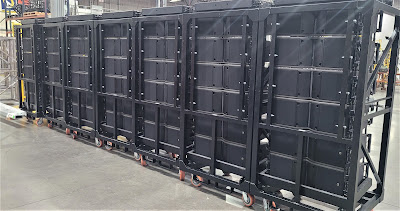
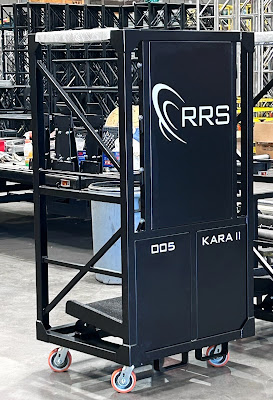
DELAY SPEAKER TOWER / V-TOWER

SKY-HOOK'S FOR RENT

When that special time comes, and you need to hang that Speakers, or Anything from one point, and there is only air to hang from, call In-House Production. In-House Production is able to offer that One Point "SKY-HOOK" to hang that one thing anywhere. Pools, Yards, Parks, Convention Space, Parking Lots, Lake, River or in the middle of the Desert, Orchards, Ball Fields, Horse Corrals, AnyWhere you need a "SKY-HOOK".

In-House Production's "SKY-HOOK" can carry 1200 pounds up to 30' high with Wind Loads to 35 mph with standard setup. "SKY-HOOK" can hang that 4'-0" wide by 2'-6" deep by 8'-0" tall cabinet with no problem. After winds of 35 mph, plan to have the item hanging from the "SKY-HOOK" lowered to the ground.

Call now and reserve your SKY-HOOK'S for that Summer Outing or Pool Party
In-House Production * 6620 W Arby Ave * Las Vegas, NV 89118
t: 702-631-4748 * f: 702-631-4027 * www.ihplabor.com 

Tuesday, March 13, 2012

Platforms and there use.

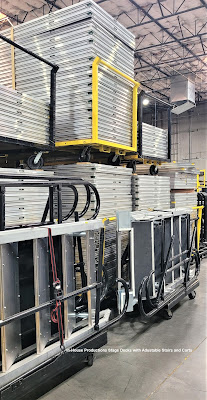
I have added several uses of In-House Production platforms we have for rent. Several ideas for the use of In-House steel platforms with legs. Here are 2 ideas for the rental platforms.

The first is used to make a 8' wide by 12' long and 6' high platform. This has stairs with railings on both sides of the stairs and on all 4 sides of the platform leaving an opening for the stairs and its handrail. We had added 6' Black Skirting to dress it up. As you look at the photo at the top of the stairs you will see no skirting. This was done to show the platform. Any size and height can be built with skirting.

6' high platform for convention on-lookers
Second photos are used as a handicap ramp. This is used as a temporarily replace the permanent ramp, as they work on the area too beautiful. This handicap ramp has less then 1" high to 12" long rise. Ramp was 25' long from end to end and 4' wide with handrails. The ramp used a small space from the steps and walkway going into the building. Steve Ray at Mikon Construction Company INC was pleased with the look, cost and install time to put in place. 


Temporary Handicap Rental Ramp In-House Production

Temporary Handicap Rental Ramp from In-House Production

In-House Production * t: 702-631-4748 * f: 702-631-4027 * www.ihplabor.com
   

Thursday, March 1, 2012

5 Reasons You Need to Meet in Person

5 Reasons You Need to Meet in Person

My clients are just like yours: They want to Skype, email and text. But here's why you still need face time.
3,905
Share
Tweet


When the daily avalanche of emails and voice messages gets overwhelming, it’s so tempting to retreat to my office and start typing replies and returning phone calls. That’s one of the biggest mistakes I can make.

No matter what industry we’re in, we’re all in the people business. We’ll only be successful if we really get to know our customers and colleagues. Many of my tech marketing clients are so busy that they now prefer texting to even emails or calls. Skype, WebEx and audio calls are convenient and create the illusion we’re actually having a meeting -- but nothing beats the power of a truly personal, face-to-face connection.

What can you learn from an in-person meeting that you can’t from a virtual one?

1. You're off the record. In Silicon Valley and many other places, there are few private offices. Many of my clients work in cubes and can’t have private telephone conversations with me or anyone else. This means that when I talk to them on the phone, I might not get to hear the most important information they can share: the unique team dynamics or executive’s personality quirks that would make or break our ability to match an expert consultant. Over sushi or a latte or a walk around the block, my clients can let me know more -- with more color -- than they can over the telephone or in an email.

2. Make use of not-so-small talk. Most business conversations are focused on solving a problem quickly and efficiently, while business relationships are built when people take the time to share and learn more about each other. That happens more naturally in person than over the phone or in an email. What cements a bond between people? Small talk about a favorite team, passion for pecan pie, parenting challenges, and the other bits and pieces that make us unique and interesting.

3. Make an impression. I bought a new handbag. It’s faux ostrich and it’s pink. Really pink. I’ve received compliments on it from every woman (and one man) I’ve met with in the past two weeks. I had worried it was perhaps not professional enough for business. But the style and color were bold, “spring-y” and made me smile. Who knew my $60 knock-off handbag would be such a great conversation starter and deliver such a strong personal statement? How do you do that over Skype?

4. Read the body language. Facial expressions often communicate so much more than words. We host consultant coffees and invite a handful of independent consultants to our office in order to better understand the nuances of each professional in a relaxed setting. We need to know what isn’t on the resume that makes each person unique. In their eyes and in their body language, we can see confidence, empathy, fear, friendliness or sincerity. That ability to “read” a candidate beyond their keywords is a huge competitive advantage for us.

5. Learn where the action is. I find out so much when I visit one of my clients in their office. Is the lobby bright and inviting with recent accolades proudly displayed? Do employees seem happy? Is there free juice and healthy snacks in the cafeteria? Brand new Herman Miller chairs in the conference room? Is everyone moving in slow motion or is there a palpable buzz? The environment speaks volumes and may factor into your business proposal or plan. By understanding company dynamics, we can communicate more effectively to meet their needs.
I love new technologies that allow me communicate with others more freely and quickly. But as a business owner, I try to remember customers want to work with someone they can relate to, not just buy from.

And I believe in walking the walk. Want to meet me in person? I'll be at the Faz Restaurant lounge in Pleasanton, California on Wednesday, March 7 between five and seven. Meet my team and join us for a drink. RSVP to @renesiegel.

I’ll be the one with the really pink purse.
In-House Production
702-631-4748 o
pat@ihplabor.com

Wednesday, February 22, 2012

WORKING WITH JACKS.


Does your job require you to work with jacks? Let's take a look at some very important guidelines regarding the safe use of jacks.

Jacks are generally known as lifting devices. In order to safely lift a load with a properly functioning jack you must know two things. First, you need to know the weight of the load you wish to lift. Second, you need to know the lifting capacity of the jack. This is important because a jack used to lift a load that is too heavy for it, is highly likely to fail. This failure could result in injury or property damage. Consequently, jacks are required to be legibly labeled and label placement should be permanent in a prominent location on the jack. Labeling can be done by casting, stamping, or other suitable means. Before using a jack, make sure it is rated with enough lifting capacity for the load you intend to lift.

The jack must be stable when used in order to prevent shifting or toppling. The jack can be blocked at the base or at the lifting point (cap) to prevent the possibility of slippage and to provide a stable base for the lifting operation. Don't try to jack beyond the jack's stroke limit. All jacks have a limit of travel that must not be overrun. Once the load is raised to the desired height, it must be secured at once by cribbing or blocking. Jack stands are often used for this purpose. Whatever method of securing the lifted load, make sure the weight of the load can be safely supported.

There are many kinds of jacks and they all must be maintained properly. Lubrication of all moving parts is important for proper operation. Hydraulic jacks operated in freezing temperatures must be supplied with an anti-freeze liquid. Jacks must be inspected for proper service at regular intervals. Inspecting a jack before and after use is always a good practice. Any time a jack is sent out for service or is modified in any way it should be inspected for defects. Any jack that is subjected to shock or overloading must also be inspected for defects and proper operation. If a jack is used at the same shop over time, it must be inspected in six month intervals; however it is still a best practice to conduct a pre-use inspection every time it is used. If defects are found, a jack must be tagged out of service and not used until repaired.

Sometimes jacks don't look like jacks you may have seen before. Material handling lifts often incorporate hydraulic pistons to achieve the lift. Engine hoists use lifting mechanisms just like a jack and fall under the same requirements. What about a manual hydraulic bearing press? They use a hydraulic piston to exert force. Is this considered a jack? Well maybe not, but just as with any tool, inspection and maintenance is required. Exercise caution with jacks at work and at home. Make sure they are up to the task.

This month's safety tip was submitted by Safety Consultant William Bartlett. For additional information on this or other safety and health topics or for a schedule of FREE training courses offered by SCATS, call toll free 1.877.4SAFENV [1-(877)-472-3368], or visit www.4safenv.state.nv.us
February Safety Tip: Working with Jacks

Wednesday, December 21, 2011

RENT A GANTRY AT IN-HOUSE PRODUCTION

 YOU CAN RENT ALL OR PARTS OF THIS GANTRY, TRUSS, I-BEAMS, MOTORS, TROLLEYS, WE ALSO HAVE THE LABOR TO INSTALL THIS. CALL US AT 702-631-4748


T6061 WITH 5" INSIDE TUBE. 


SPIGOTS ADDED TO TOMCAT TRUSS. WE AT IN-HOUSE PRODUCTION NOW HAS 2 - 42' RUNS OF 20.5" TRUSS THAT HAS BOLT PLATE ENDS AT EACH END OF THE 42' TRUSS. THIS IS TO BOLT TO CORNER BLOCKS FOR OUR TOWER TRUSS OR GANTRY FOR SPAN.  SPIGOTS FROM 6061 ALUMINUM WITH 5" PLACES INSIDE OF TRUSS TUBE AND WELDED FOR STRENGTH.
IN-HOUSE PRODUCTION 702-631-4748


Tuesday, November 1, 2011

Pay for All Working Time: The De Minimis Rule Q&A

Q: We have a supervisor who allows nonexempt employees to begin work a few minutes before their shift begins or to continue working “off the clock” for a few minutes after the shift ends to finish up a project. We are concerned that this time is not being properly logged on time sheets and paid as required under wage and hour laws. The supervisor says the time does not have to be paid because it is considered “de minimis” under the FLSA. Is he right?

A: Not if this “off the clock” or extra work occurs on a regular basis. Under the Fair Labor Standards Act (FLSA), nonexempt employees must be paid for all hours actually worked. According to Department of Labor (DOL) regulations implementing the FLSA, if you are aware that nonexempt employees are working extra time, you must compensate the employees, even if you did not specifically request the additional work and even if it is not reflected on their time records. (You will find these regulations codified at 29 C.F.R. §§785.11 – 785.47.)

The supervisor is correct that there is a “de minimis” rule, but he is not applying it properly. The Supreme Court recognized a “de minimis” rule in Anderson v. Mt. Clemens Pottery Co., 328 U.S. 680 (1946). According to the Court, insignificant amounts of time do not have to be counted as work time, such as when an employee spends a few extra seconds or minutes working.

This rule often has been misunderstood by employers who incorrectly conclude that they can require or permit employees to report a few minutes before their scheduled starting times or stay a few minutes later on a regular basis without paying them for that time. The DOL regulations specifically reject this interpretation. The regulations state that employers do not have to count the time “only where there are uncertain and indefinite periods of time involved of a few seconds or a few minutes duration and where the failure to count such time is because of considerations justified by industrial realities. An employer may not arbitrarily fail to count as hours worked any part, however small, of the employee’s fixed or regular working time or practically ascertainable period of time he is regularly required to spend on duties assigned to him.” (This regulation is found in 29 C.F.R. §785.47.) In other words, the de minimis rule should not be used broadly as a device to avoid clocking legitimate working time.


So, if nonexempt employees are regularly working extra time before or after their normal shifts, this pattern would not meet the DOL’s description of “uncertain and indefinite periods” that may be excluded from paid working time. And, the fact that your supervisor is allowing this practice only underscores that it should be paid working time since he is aware that they are working the extra time.

Further, you also should make sure your policies are not inadvertently encouraging this practice, such as by indicating that employees are not permitted to begin work more than 15 minutes before their scheduled starting times or to stop work more than 15 minutes after their scheduled quitting times. This type of wording implies that employees may work up to an extra 30 minutes each day without having the time counted for pay purposes. 

Accordingly, you should pay for the working time, even if it is not recorded on time sheets, since one of the surest ways to provoke a wage and hour complaint is not to pay employees for time they have worked. Be aware, too, that the extra time may cause the employee to work more than 40 hours in a single workweek and, thus, trigger overtime obligations as well. 
HR Matters E-Tips
Personnel Policy Service, Inc

In-House Production
www.ihplabor.com
702-631-4748
ENTERTAINMENT LABOR AND PAYROLL SERVICE.

EMPLOYEE OR INDEPENDENT CONTRACTOR

Employee Or Independent Contractor: One Way Of Thinking It Through

By John McLachlan


Deciding whether an individual is an employee or independent contractor is becoming an ever more important question. Employers should carefully scrutinize each and every independent contractor relationship which exists within the business before the Labor Department, the IRS, or a state agency does it for you.

While the issue is taking on a new importance in light of federal and state attention, the criteria for the determination of bona fide independent contractor status have not gotten any clearer. Nor will this article provide a way for you to determine with legal certainty which is which. While we have no magic formula which answers every question, we do want to provide a "rule of thumb" or a "quick-scan" way of thinking about the subject which can help to raise questions about independent contractor relationships where they should be raised.

Show Me The Money

One fact that is certain is that the price and penalties for misclassification of employees will get ever higher. As one example of the increasing danger to employers who utilize independent contractors, earlier this year the DOL and the IRS entered into a Memorandum of Agreement by which the two agencies as well as a number of participating states (Connecticut, Maryland, Massachusetts, Minnesota, Missouri, Utah, Washington, Hawaii, Illinois, Montana and New York) have agreed to share information about independent contractor relationships.

Much of the reason for the renewed interest in the distinction between employees and independent contractors has to do with state and federal revenues. Employers pay payroll and other taxes on wages they pay to employees – but not on payments to independent contractors.

This apparent benefit quickly becomes illusory in light of the penalties and back taxes which are levied when independent contractors are found to actually be employees. Another argument against a too-quick designation of independent contractor status is the presumption that everyone working for an employer is an employee. This presumption can be overcome by facts that establish a lack of employee status, but in case of doubt, the default position is inevitably in favor of employee status.

If it were easy to distinguish between employees and independent contractors, there would be no reason for this article. But as you may have guessed, it is actually quite complicated. The tests to determine whether an individual is a bona fide independent contractor are multi-tiered and subject to different interpretations. And if this weren't bad enough, the rules for determining an individual's status can differ, depending on which agency is asking the questions.

Rather than review each agency's tests for determining a legitimate independent contractor relationship, we can draw analogies to an indisputably independent contractor relationship – putting a new roof on a home. While this analogy only goes so far and is an oversimplification, it nonetheless illustrates a number of the tests used to distinguish between legitimate independent contractors and employees.

Dealing With A Roofer (make the roofer a stagehand)

A typical homeowner in need of a roof will find one or more contractors in the business. After locating one or more, the homeowner reviews qualifications, discusses price, and gets bids. After settling on details such as when the job will be completed, a contractor is ultimately selected to install the roof.

From there, it's the contractor who hires the proper number of individuals to install the roof, and who directs their work. The homeowner will not tell the contractor how the job is to be done (so long as it is done safely, and the premises are not harmed). The contract between them will include agreement about the job's completion date and the required quality of the final installation. Typically also there would be agreement on a schedule of payments which would be tied to the progress of the job.

When the roof is finished to contract specifications, the contractor receives the final agreed upon payment and the homeowner and contractor go their separate ways, likely never to do business with each other again.

Applying The Economic Realities Test

The roof installation model is a simplistic illustration but it reflects a number of factors used by government agencies and courts to scrutinize the legitimacy of a claimed independent contractor relationship. While this model doesn't include all of the relevant factors relied upon, it does provide a preliminary view into the examination which must be undertaken. It should be considered an initial screen, which, if not passed, at a minimum will be sufficient to alert employers that their use of independent contractors should be further analyzed before any federal or state authorities begin to consider the situation.

We will use the DOL set of criteria called the "economic realities test." Again we add that these are not the only criteria used by state and federal agencies, but they provide a reasonably comprehensive overview for the initial self-examination we are proposing for employers who use independent contractors in their businesses.

Control Of The Work

In our example the homeowner imposed very little direction on the actual roof installation. The homeowner set the requirements as to what final results were expected, but the method of obtaining that final result was left to the contractor. In a business context, the more control the business exerts over the manner in which the required work is accomplished, the more likely the relationship is that of employer and employee.

Investment By The Contractor

Our hypothetical roofing contractor provided all the tools and equipment he needed to install the roof on the home. On the other hand, the more a business provides the tools and equipment needed to perform the work, the more the relationship looks like that of employer and employee.

Opportunity For Profit

The roofing contractor was in charge of the ultimate amount charged for the work. He could have charged more or less for the job, depending on a number of factors exclusive to himself, such as how much profit he wanted to make on that particular job, the efficiency of his roofing crew, whether or not he was busy, etc. The less opportunity for profit, or the more an individual appears to be paid on an hourly basis, the less likely is a finding of independent contractor relationship. Payment on an hourly basis does not by itself negate a finding of independent contractor, but it is not helpful to that end.

Use Of Initiative And Judgment

The more efficient the roofing contractor, the greater is his opportunity for profit. If he has a highly trained roofing crew, he can increase his competitive relationship to other contractors. If he has invested in more efficient roofing equipment, he may be able to finish jobs faster and thus have a competitive edge over other contractors he is competing against. If he has developed a more efficient system for the installation of a certain roofing product, he will lower his costs and improve resulting profit margins.

In contrast, an employee works for an agreed- upon wage and does not have the opportunity for profit or loss. Of course, there is the possibility for career advancement for an employee, but this would take place over a period of time and an employee does not have the same opportunity for profit – or loss – as does the independent contractor.

Permanency Of The Relationship

Our roofing contractor finished the job and moved on to the next job with another homeowner. When the roof was installed, the relationship was over. Shorter or clearly defined discrete projects with a beginning and ending point are more closely associated with the independent contractor relationship and longer engagements look more like employment relationships.

Integration With An Organization's Business

In our example putting a roof on the house had no connection to the homeowner's primary employment or means of making a living. By the same token, the more central the work performed by the independent contractor is to the proper functioning of the business, the more the relationship looks like that of employer – employee. And certainly if the same work is done by employees and by independent contractors, that would be an extremely strong argument that the independent contractor is actually an employee.

Obviously each factor listed above does not always have one clear answer and a state or federal agency or court will consider all of the above factors as well as others in reaching a final determination whether there is an employment relationship rather than one of independent contractor.

Don't Try This At Home

While not fail-safe, this cursory summary can help you to identify where problems may exist. If you find questionable situations after this cursory examination, it is much preferable to contact your employment counsel to get certainty rather than let the government answer the question for you. You can get some additional information by visiting our website or our Wage and Hour Laws Blog.

For more information contact the author at jmclachlan@laborlawyers.com or (415) 490-9000.

In-House Production
www.ihplabor
702-631-4748